
Et tu, Substack?
Why I left Substack for good, and started my own website instead.
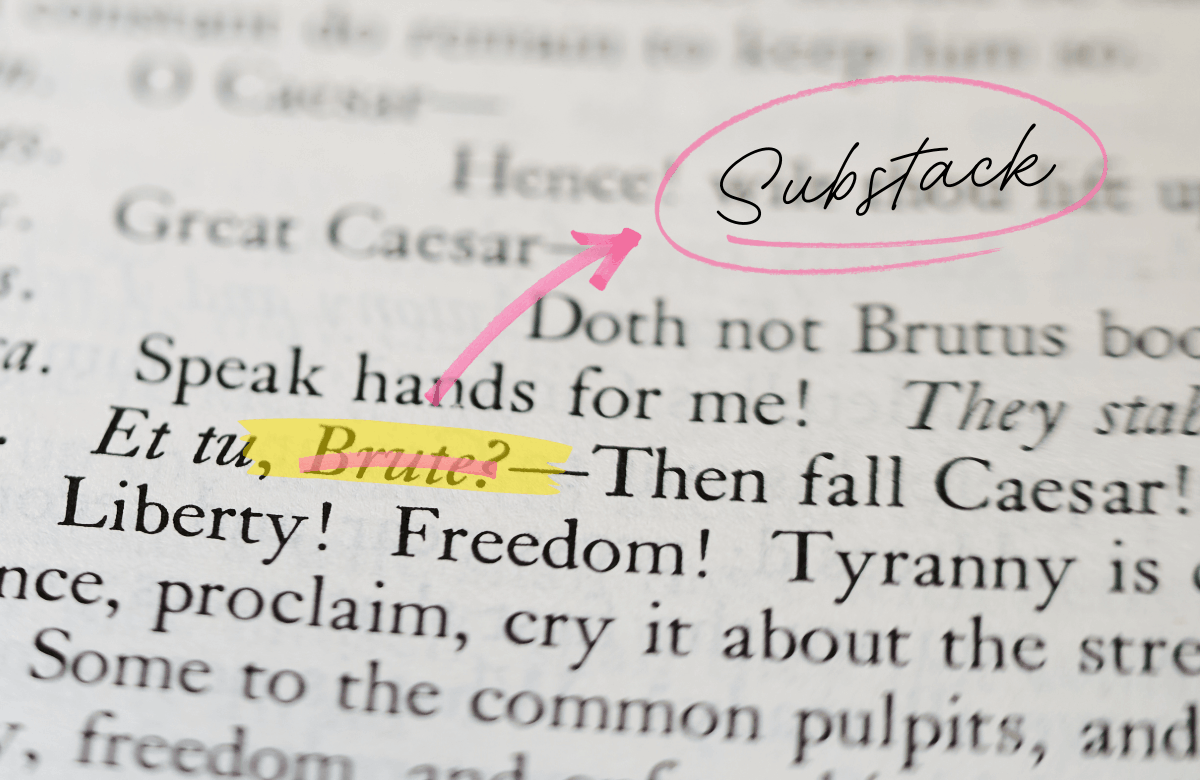
All weekend I’ve had the famous quote from Shakespeare’s Julius Caesar in my head — Et tu, Brute? (You too, Brutus?)
If you’re not familiar with the line, it’s said by Caesar to Brutus in the play when he identifies Brutus as being part of a group of political rivals who conspire together to stab and kill him. Caesar had believed Brutus to be his trusted ally and, over time, the quote has evolved into a shorthand way of marking someone out as a traitor.
So…
Et tu, Substack?
If you’re not immersed in the world of Substack, then you likely missed the hubbub last week after Substack announced a new, unexpected partnership. Substack said:
“We’re partnering with Pangram, the leading AI-detection tool. You’ll be able to scan notes, replies, comments, and posts to see an estimate of how much of the text was written by hand or with AI assistance.”
First and foremost, it’s important to know that Pangram is itself an AI company; it uses AI to detect AI. 🙃
Substack has always been a platform that writers consider a rare, sacred space because it’s positioned itself as a social platform where writers can have full ownership and control over their writing, and their writing community. Which is why their new partnership is quite confusing — particularly because writers are the last cohort you could ever imagine embracing ties with a venture capital-backed AI platform.
AI companies are notorious for training their Large Language Models (LLMs), like ChatGPT and Claude, by unethically and illegally stealing from writers by scanning their copyrighted books, research papers, essays, journals, blogs, and every other type of writing it can scrape from the internet. Just last week, the company that runs Claude, Anthropic, paid $1.5 billion to settle a class action lawsuit brought against them by authors for illegally using their books as training material for its AI chatbot. It’s safe to say that writers and AI companies do not make good bedfellows.
But the spin doctors over at Substack were keen to insult our intelligence assure us writers that Pangram is a good AI company that provides good AI tools, and that we could trust their dedication to providing industry-leading transparency. By allowing readers and writers to quickly name and shame ascertain who’s using AI to write their articles, and who’s not, we’d be in control of choosing what kind of content we, as readers, want to engage with — because apparently this is a decision we’re incapable of making on our own, using our human brains.
Sure, it might sound benign enough for a second if you ignore the whole AI vs Writers issue that underpins everything. But if you scratch the surface you’ll quickly find a fairly large caveat — there’s not a single AI platform that currently exists that can accurately detect AI writing. So, as many Substackers were quick to point out, this will quickly devolve into little more than an AI witch hunt/purity test. Not to mention the risk of a false AI positive will only strike (even more) fear into the hearts of every writer before they hit the publish button. Who doesn’t love a little unnecessary Russian Roulette added to their day? 👀
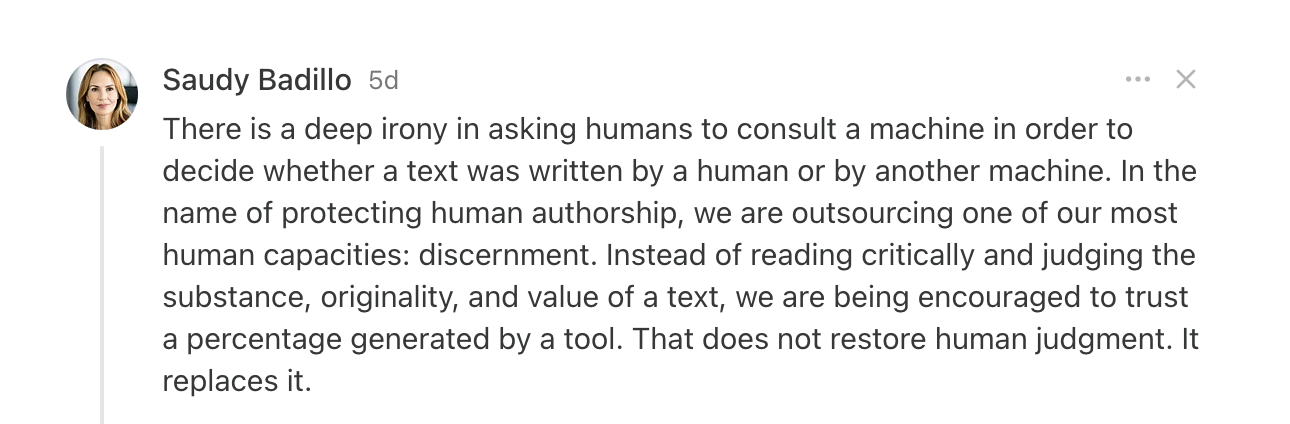
I’ll get to the meat of why this partnership is irking so many writers who don’t use AI (like myself) in a minute.
But first I want to make it clear that using AI as a writing tool isn’t inherently bad, and shouldn’t be viewed as a binary good/bad label. Many people use AI not because they’re lazy, or because they can’t write well, but out of necessity. There are writers with disabilities who, without AI, would otherwise not be able to literally get words onto the page and make their voices heard. Whether it’s a physical disability, neurodivergence, or language barriers that require translation to reach a specific audience, AI tools do have their place.
So when these under-represented writers finally have access to a platform that has given them the freedom to express themselves, Substack is going to disproportionately punish them by slapping an AI label on their work, and force them to call attention to a disability that’s nobody’s business except their own? That shouldn’t sound like a good idea to anyone, much less to the Executives who run what’s often billed as the friendliest corner of the Internet.
Aside from that rather large issue, AI tools like Pangram are also known for their biases and false positives when it comes to AI detection — not to mention exaggerated accuracy claims, and… the biggest elephant in the room… stealing from writers.
What Substack handily glossed over in their announcement was the array of red flags popping up in our writerly brains, including the weightiest question of all: will our writing now be used to train the next generation of f’ing LLMs? The same LLMs that authors, academics, and publishing houses are already fighting so fiercely against, even in courts?
When Substack was asked this question, they were quick to direct everyone to Pangram’s user agreement. In it, Pangram muddily claims that they do not train their own AI from articles scanned on their site — instead they train from third-party data sets. But Substack isn’t their site, so does this agreement now make Substack in its entirety a third-party data set? Nobody seems to know for certain, and Substack isn’t offering up any additional comment as of now.
It’s safe to say that Pangram’s murky wording isn’t providing comfort to any of us writers — we’ve all been around the block a few too many times now with venture capital-backed apps. Fool me once, and all that…
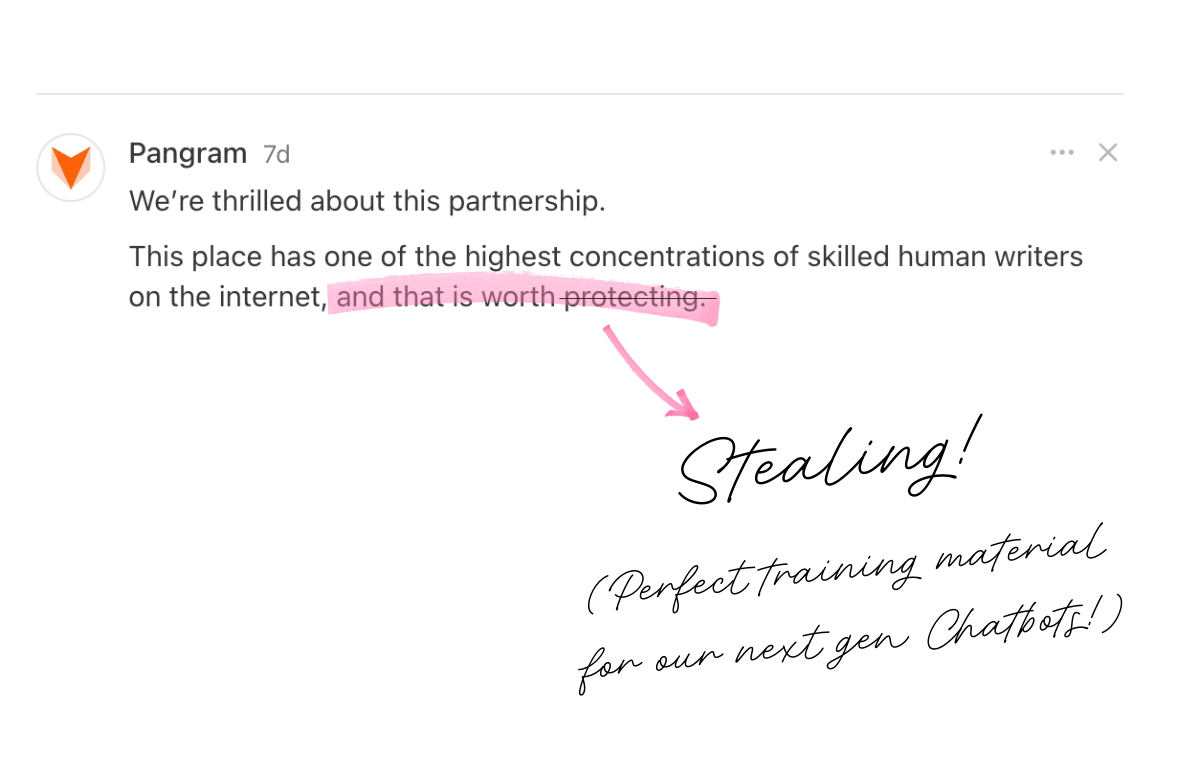
The real kicker in all of this was that, although Substack’s announcement said you’ll be able to — implying the AI tool would be our choice to use or avoid — the reality is that Substack had no intention of providing writers with a way to opt out of using this tool. As things stood at launch, whether we liked it or not, every Substack writer would be forced to have every piece of their writing uploaded and scanned by Pangram in order to steal content for training purposes receive an AI vs Human rating that would be displayed on Substack. And if you get a false positive? Not to worry! You can report a detection error, and explain to Pangram why its tool got something wrong. Oh thank goodness; we can help train the bots one-on-one! 🙄
(Note: Since launch, Substack has slightly backed down on this forced upload to Pangram — emphasis on slightly — but the trust is broken. Substack’s allegiance is not to the writers, and they’re just as duplicitous as every other tech company out there.)
In case it’s not clear, I’m angry about Substack’s decision. I could write out all of my reasons, but plenty of more-skilled writers with far more expertise on the subject have written insightful and in-depth pieces already, so I suggest reading Dr. Sam Illingworth’s article here, or Jessica Smock’s article here to get a better sense of what’s frustrating so many of us on Substack since the announcement.
In truth, I shouldn’t be surprised by Substack’s latest move given that they have form with this sort of thing. A few years ago it was revealed by The Atlantic that Substack had a substantial problem with allowing Neo Nazis and other nefarious actors to use, and profit from, the platform. More recently, The Guardian explored exactly how Substack was itself profiting from despicable platforms promoting antisemitism, far-right ideology, and misogyny. Substack’s official response to these investigations has been little more than an unbothered shrug.
In hindsight, I should have avoided returning to Substack altogether when, after years away, I logged in and was suggested Andrew Tate’s Substack as an account I might like to follow. Clearly I’d been away long enough to confuse the algorithm, and it was disconcerting to see that Andrew Tate was the default suggestion for newbies.
On a personal level, part of why I started the Curious Ones originally was to bring humanity together from different parts of the world. When I returned a couple of months ago it was to follow a similar thread while also pushing back against the general, ongoing enshitification of our world. Part of my mission for tCO states explicitly that I’m deeply worried about the lack of curiosity being baked into society by the unregulated and forced use of LLMs and AI — which is why I cannot, in good conscience, continue to be an active contributor on Substack’s platform. Even if Substack walks back the partnership entirely, the writing is on the wall.
Now, I’m not naive, and I’m certainly not laboring under the delusion that leaving Substack will solve any of my concerns, nor will it keep my writing safe from being used to train AI models. I’m fully aware that, regardless of where I publish my writing, absolutely every word I ever put on the internet will be greedily absorbed by hungry LLMs and bots at some point. As of now, there is absolutely no reliable way for any of us to avoid this reality.
There’s a difference, however, between knowing something’s happening beyond our control, and actively sticking with a platform like Substack that has thrown us writers under the bus, and then had the nerve to pretend it was for our own good. I know that creatives have a reputation for living in their own bubbles, but that doesn’t mean we’re incapable of using our brains and spotting a traitor in our midst.
For transparency, I do not intend to boycott other writers who choose to stay with Substack. I’m aware of how much that would hurt the many, many writers who have spent years building their careers around Substack, and who don’t have the luxury of picking up and going elsewhere easily. I’m lucky to be at a very early stage with Substack, and therefore leaving the platform is not hugely impactful to my life. I have seen so many Substackers over the past week hemming-and-hawing over very real, complex, moral and personal decisions since Substack’s announcement, so I do not judge those who continue to stay, and I don’t minimize their dilemma — times are tough!
Anyway, I genuinely never intended to write this much on Substack’s AI pivot, but it felt necessary to explain to you, my readers, why this platform is no longer the right fit for me. I know I mean absolutely nothing to Substack, and that my departure will have zero impact on their business. But it’s so rare these days to have the opportunity to stand up for something we believe in, so I’m taking the small wins where I can. Staying true to my own moral compass feels so much better than carrying around resentment for the platform each time I hit the publish button.

Visual representation of how it feels to be an aspiring writer (of a certain age), and figuring out the industry rules/expectations for the first time. Rule one is that very little of it involves actually writing.
I just read yet another article this morning from a literary agent reminding us aspiring writers about the importance of maintaining an online personal brand and community — this seems to be a key requirement of the industry if you want to make it in the writing world these days. Sigh. (See above visual for a look inside my current headspace as I try to navigate the writing world’s expectations.) Which is why I’m here, building a website, and relaunching the Curious Ones under my own, personal umbrella while I also work on other writing projects behind the scenes.
It’s disappointing that Substack chose to go the way it did, but here’s to pivoting to new paths when the old ones fail!
One Last Thing…
Can I hop on my AI soapbox quickly?
Aside from everything above, and the moral and ethical implications of it all, I also want to mention my deep concern about the absolute havoc that frivolous AI use and AI data centers are wreaking on the world’s natural resources — water resources are being decimated, and the damage it’s doing to the environment in general is already devastating, and will become catastrophic if something doesn’t change.
In a summer where the news has been dominated by one Climate Change crisis after another, it really takes the cake that Substack chose this moment to announce an AI partnership with such glee. As if the environment needs the added weight of Substack’s new, pointless AI use. The environment is not okay, and AI is incontrovertibly linked to making it worse.
If you’ve avoided reading about AI, or don’t consider yourself knowledgeable on the topic, then I would really encourage you to take some time to educate yourself, even briefly, in whatever form is easiest for you to digest. I am far from an expert, but I’m aware enough to know that there are many long-overdue conversations that we, as a society, should all be having about its effects on humanity and the environment.
There are a couple of podcasts I’ve recently listened to with former employees of major AI/tech corporations who have now pivoted into educating others about what’s coming down the pipeline in an AI world. If you’re curious, you can listen to/watch one here, and another one here. Oh, and Erin Brokovich is on the case now, too. Listen to her here.